LE GOLFE / Nature / Mushrooms
MUSHROOMS IN THE GOLFE.
AUTUMN BENEATH THE OAKS.
After rain, discover the Golfe at leaf level. Look out for Caesar’s mushrooms, parasols and porcini, then milkcaps; chanterelles and black trumpets may extend the woodland season. The real appointment is with the weather, trees and ground conditions.
LE GOLFE · Details checked on
- What matters
- Moisture, temperature and ground conditions
- The landscape
- Maures oak woods · pine woods for milkcaps
- The calendar
- Flushes overlap and vary between years
- Before eating
- Certain identification; expert checking whenever in doubt
THE LE GOLFE TAKE
For porcini, start by exploring oak woodland, including the cork-oak landscapes of the Maures. Choose an open, authorised area and enjoy the walk: a full basket is a possibility, never a promise.
Before filling your basket
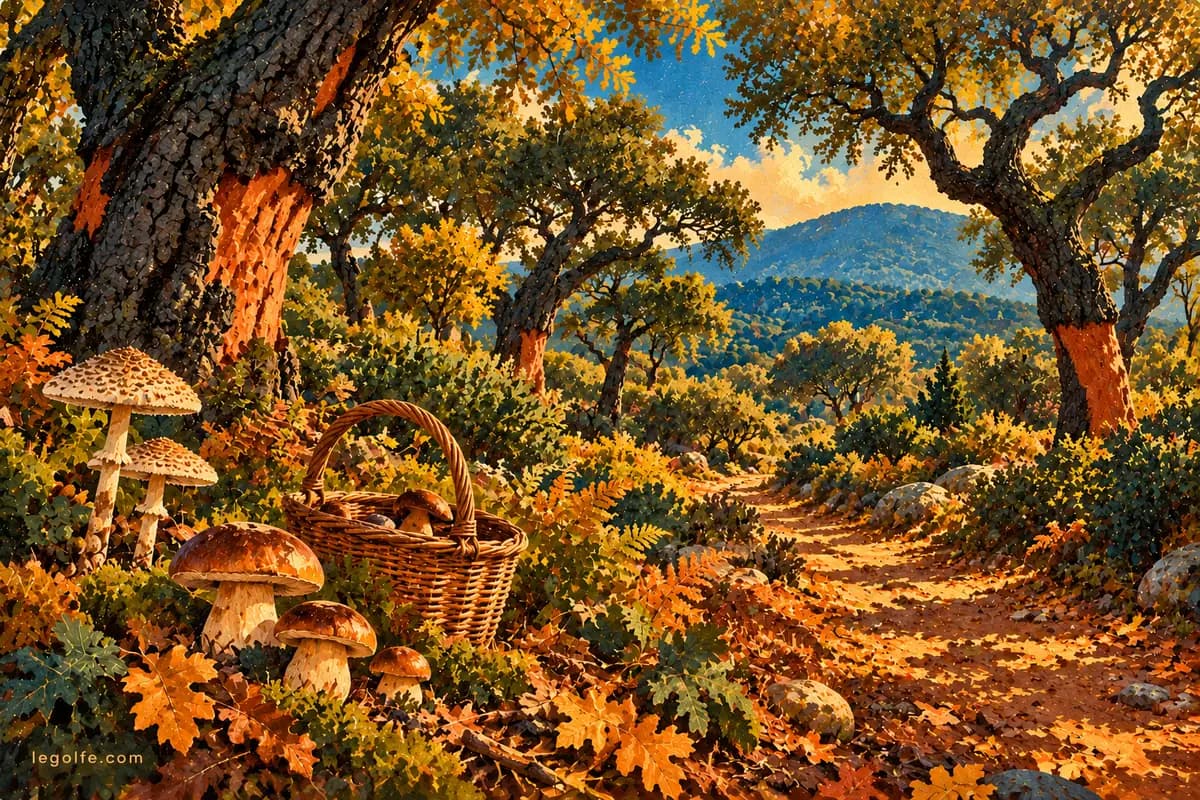
This page helps plan an outing, not determine whether a mushroom is edible. The cover illustration and species names are not identification tools. If in doubt, do not eat a specimen before a mycologist or suitably knowledgeable pharmacist has checked it; an app or photograph alone is not enough.
Collect only species you know thoroughly, keep specimens whole for checking and separate species in your basket. Avoid polluted areas and roadsides. Follow Anses guidance before consuming any wild mushrooms.
References: Anses · Recommandations de cueillette, annexe du rapport de toxicovigilance
Caesar’s mushrooms, parasols, porcini… and later flushes
Our local thread begins with Caesar’s mushrooms, parasols and porcini while autumn retains some warmth. Their seasons overlap: rain does not bring the same flush everywhere, and a dry spell can interrupt it. Mycological observations record bronze boletes and Caesar’s mushrooms well before mid-autumn.
Milkcaps then draw attention towards pine woods. Chanterelles and black trumpets may accompany wetter outings, but they do not follow a fixed sequence: chanterelles can appear earlier too. These are habitat pointers, without a guaranteed calendar or identification criteria.
| Look out for | Explore this habitat | Seasonal pointer |
|---|---|---|
| Caesar’s mushrooms / oronges | Warm broadleaf woods | Watch when warmth and moisture coincide |
| Parasols / coulemelles | Clearings, woodland edges and wooded meadows | Look at more open spaces without inferring edibility |
| Porcini / cèpes | Oak and other broadleaf woodland | Some species favour periods that are still warm |
| Bloody milkcaps / sanguins | Pine woods | A different habitat to explore during autumn flushes |
| Chanterelles / girolles | Broadleaf or conifer woodland | May appear before milkcaps; no fixed place in the sequence |
| Black trumpets / trompettes de la mort | Moist broadleaf woodland | Watch while moisture lasts; occurrence varies by area |
References: Mycocharentes · Observations du cèpe bronzé · Mycocharentes · Observations de l’amanite des Césars · MycoDB · Écologie de la coulemelle · MycoDB · Écologie du lactaire sanguin · Forêt méditerranéenne · Mycologie et écologie des espèces (1986, PDF)
Explore cork-oak woodland for porcini
Oak woods provide a rewarding thread through the Maures. Broadleaf habitats are worth exploring for porcini; bronze boletes are documented beneath oaks. Around the Golfe, cork-oak woods let you discover this landscape without travelling far.
Look at the trees and woodland conditions rather than following a supposedly miraculous pin on a map. A promising wood may produce nothing that day. Soil, moisture and site history matter too: a cork oak guarantees neither porcini nor an edible species.
References: Mycocharentes · Observations du cèpe bronzé · Office du Golfe · Chênaies entre La Garde-Freinet et Grimaud, par les Vernades · Office du Golfe · Forêt de chênes-lièges au San Peïre
Three starting areas for discovering the woodland
Between La Garde-Freinet and Grimaud, routes via Les Vernades pass cork-oak and chestnut woodland. Around Le Plan-de-la-Tour, San Peïre brings cork oaks into a granite landscape. Official descriptions of the Cogolin-to-Giégi route also mention cork oaks, scrub and pines.
These are areas for observing woodland, not certified collecting spots. Choose a suitable route, read its description and stay in areas open to visitors. A public path does not grant permission to collect in neighbouring plots.
References: Office du Golfe · Chênaies entre La Garde-Freinet et Grimaud, par les Vernades · Office du Golfe · Forêt de chênes-lièges au San Peïre · Office du Golfe · Paysages forestiers vers Giégi · CNPF · Cueillette et propriété forestière
Open woodland does not automatically mean collecting is allowed
Check ownership, signs and local rules before taking anything. ONF distinguishes state-owned forests, where limited family collecting is allowed unless local rules say otherwise, from other woods where the owner’s permission is needed. Do not apply that permission to the whole Maures forest.
Respect closures, forestry-work notices and hunting signs. Check forest-access information as well. An outing can wait; choose another open route or a village stroll when an area is inaccessible.
References: ONF · Autorisations et bonnes pratiques de cueillette · CNPF · Cueillette et propriété forestière · Office du Golfe · Carte quotidienne d’accès aux massifs
A manageable walk and woodland left intact
We prefer one walking area with time to return comfortably. Bring water, suitable shoes and a rigid basket if collecting is permitted. Tell someone where you are going and keep track of your starting point.
Protect the leaf litter, do not rake the ground and leave uncollected mushrooms undamaged. Allow time afterwards for any expert checks needed. A morning without a harvest can still be a wonderful Maures walk.
References: ONF · Autorisations et bonnes pratiques de cueillette
Practical questions.
Where can I look for porcini around Saint-Tropez?
Maures oak woodland, including cork-oak landscapes around La Garde-Freinet, Grimaud and Le Plan-de-la-Tour, offers ideas for walks. Check collecting permission; no area guarantees a harvest.
Do mushrooms always arrive in the same order?
No. Caesar’s mushrooms, parasols and porcini may feature in early seasonal outings, but flushes depend on conditions. Milkcaps are associated with pines; chanterelles and black trumpets are not an obligatory final stage.
Can I identify a species from this guide’s illustration?
No. It is an AI-generated atmosphere illustration. Never use it to decide whether to eat a mushroom; ask an expert to check whenever in doubt.
Make your plan.
Places in this guide.
Sources. Current details.
Prepared by LE GOLFE using the sources below. Suggested pace and day plans are our editorial recommendations. Check venues and transport operators for openings, prices and availability on your dates.
- Anses · Recommandations de cueillette, annexe du rapport de toxicovigilance
- CNPF · Cueillette et propriété forestière
- ONF · Autorisations et bonnes pratiques de cueillette
- Forêt méditerranéenne · Mycologie et écologie des espèces (1986, PDF)
- Mycocharentes · Observations du cèpe bronzé
- Mycocharentes · Observations de l’amanite des Césars
- MycoDB · Écologie de la coulemelle
- MycoDB · Écologie du lactaire sanguin
- Office du Golfe · Chênaies entre La Garde-Freinet et Grimaud, par les Vernades
- Office du Golfe · Forêt de chênes-lièges au San Peïre
- Office du Golfe · Paysages forestiers vers Giégi
- Office du Golfe · Carte quotidienne d’accès aux massifs